
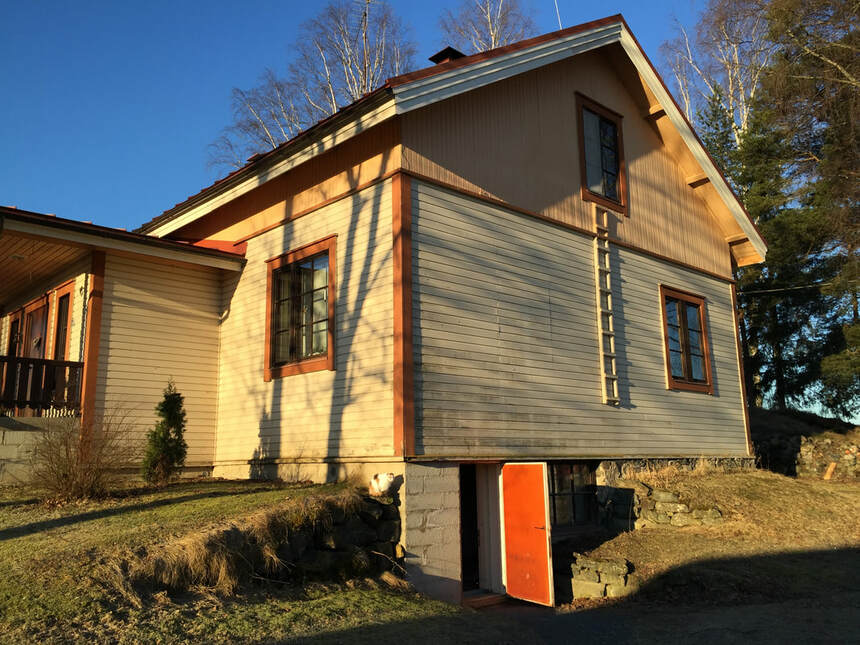
How does mechanical exhaust ventilation work in an old single-family house?
Between 1970 and 2000, the ventilation systems of detached houses and other buildings were built with mechanical exhaust, meaning that a standard-sized extractor fan was chosen for the roof, which was usually too large and lacked any significant adjustment options. The extraction creates an undesired negative pressure in the house, as a result of which replacement air is sucked in from, for example, a fireplace flue containing fine particles or from the corners of walls, from between the insulation.
Replacement air vents in walls or windows are often twisted shut in winter because they let in freezing air that chills the floors and causes a draft.
As a result, the negative pressure has increased even further. In light of current knowledge, mechanical exhaust ventilation should be classified as a risk structure if the adequacy of replacement air has not been ensured. Mechanical exhaust also weakens the building's calculated energy certificate because it causes high heating costs, which as a result can cause environmental pollution.
Problems caused by mechanical exhaust ventilation in old houses
The problems with mechanical exhaust ventilation in old houses are:
- The fireplace may work in reverse when there is no fire.
- Heating costs increase when freezing air is sucked into the building in winter
- High negative pressure increases radon concentrations, and it can be thought that the indoors become part of a radon suction device
- The floors are freezing even though the indoor air in the living zone and near the ceiling is unnecessarily warm (23-26°C).
Having now toured hundreds of single-family homes, I can agree with the conclusions of other experts that the problems associated with mechanical exhaust ventilation in old houses are significantly greater than the benefits it brings. Especially if an old natural-draft detached house is converted to mechanical exhaust ventilation.
Mechanical exhaust ventilation solves one problem by efficiently removing impurities, such as moisture from wet rooms or bad odors from the toilet. At the same time, however, it causes a pile of problems elsewhere in the building.
Problems begin when the HVAC designer selects an exhaust fan to be mounted on the roof, wall, or suspended ceiling. In reality, HVAC designers do not have many options when choosing a fan, and the fans usually lack adjustment capabilities; instead, a ”detached-house” rooftop exhaust fan is chosen, which the equipment manufacturer originally sized to handle detached houses ranging from 40 to 300 square meters. Often, the controller acts by restricting the ventilation valve in the toilet and shower. Restricting excessive exhaust causes unnecessary energy waste and rapid wear of the motors.
Replacement air in an old house is easiest drawn from where it is most readily available
When the vacuum cleaner puts the house under negative pressure, replacement air valves should also be installed in the walls or windows of an older building. Unfortunately, replacement air valves in single-family houses are often not installed, or there are too many few of them. The exhaust fan of an old detached house blows air out and then draws replacement air from wherever it can most easily.
Negative pressure is a distressing problem, especially in buildings that previously had natural ventilation. If there is insufficient replacement air, the air drawn inside usually comes first from the fireplace flue, causing the fireplace flue to work in reverse, and carbon monoxide particles, which are extremely harmful to indoor air, are sucked into the indoor air for the family to breathe. The carbons, gases, and hydrocarbons caused by wood burning in residential areas have been found to be carcinogenic.
In addition, in areas with high levels of radon, the negative pressure caused by mechanical exhaust ventilation can lead to elevated radon levels in older houses. Radon is most prevalent in winter, and in winter, replacement air vents are blocked because of the cold air, which increases the negative pressure. As a result of the increasing negative pressure, more radon than before is drawn in from the subfloor. The residents' risk of developing lung cancer increases further.
If air can no longer be obtained from the fireplace flue or the crawl space, air is drawn into the old detached house from the joints of the structures, i.e., the corners of the floor, wall, and ceiling. When this air enters, it brings along particulate matter from the insulation, which may contain asbestos or other old wool materials that are almost as hazardous, as well as germs and molds that have accumulated in the insulation over time.
Furthermore, the meeting of cold and hot air in the middle of an old house's wall structure can cause moisture to accumulate in the structure and thereby create favorable conditions for microbial growth to develop.
Freezing floors in an old detached house as a result of ventilation
In winter, mechanical exhaust ventilation reduces residential comfort by bringing in air that is too cold, which people perceive as a draft. The sensation of a draft is related to both air speed and coldness simultaneously. Cold, stationary air does not feel like a draft, but the faster the air moves, the warmer it must be to not feel like a draft, and vice versa. Air coming through replacement air vents or other window slit vents is just as cold as the outdoor air, which very quickly flushes out all the house's heat unless additional power is promptly ordered from the electric utility. In winter, cold air quickly drops to the floor level, causing feet and potentially children to feel cold.
Because the floors are cold, people tend to naturally set the temperature throughout the living areas of a single-family home unnecessarily high, so that even the floors of an old house will feel warmer. Every degree Celsius increase in temperature in an old house raises heating costs by 5 %. It’s pointless to raise the room temperature unnecessarily if it’s warm near the ceiling and cold near the floor. In general, it’s pointless these days to bring unheated air into a room.
In addition, mechanical exhaust ventilation accounts for more than 25 % of heating costs in the winter in an older single-family home; some estimates put the figure as high as 50 %. Replacing mechanical exhaust ventilation with room-by-room ventilation that recovers heat typically pays for itself faster than many other energy-efficiency renovations. It improves the energy rating on the energy certificate by several notches, thereby also increasing the value of the home.
Mechanical ventilation should simply be forgotten in old houses
Mechanical exhaust ventilation in an old detached house should already be forgotten today. At the same cost, a heat-recovery ventilation system can be built that keeps the house in balance, continuously brings warm air into the building, and ensures that moisture or otherwise dirty air does not accumulate in the building.
The cost savings achieved through heat recovery can pay for the entire renovation in 5 to 10 years. In addition, today's buyers, who are wary of mold and indoor air quality problems, appreciate proper ventilation with heat recovery. In a property transaction, heat recovery ventilation is already appreciated almost as much as a geothermal heat pump.
 Finnish
 English
 Swedish
 Spanish